Showing posts with label samurai. Show all posts

Sunday, February 19, 2012

My Fabulous Yard Sale Find:Samurai Archer on Horseback Print


Yesterday, I found a beautiful and rather well-preserved specimen of Japanese print, featuring a samurai in full armor on horseback, holding an arrow at the ready in his longbow. It appeared to be numbered “11” as if it were number 11 in a series. All other marks were kanji with a smattering of katakana. So I made a long and rather frustrating attempt to decipher the rest of the kanji, thinking my handy Denshi Jisho radical lookup might help me identify the unknown symbols. Boy was I ever wrong! I found some of them, but even the ones I found were often not part of the Joyo Kanji standard list. Obviously, one must be much more learned in this stuff than I am. 
My Mystery Samurai Archer on Horseback Print, 14.5" by 10"


The box in which the print came also held ephemera and photographs from just pre-World War I to about 1950, so I’m guessing the print is either just post WWII or perhaps earlier, especially since I had so much trouble finding the kanji. I realize that pre-WWII kanji would be carried on a list called the “kyujitai” or “original characters,” rather than the shinjitai, or newer system.  (Just to make things amusing, there’s something called the “seijitai” as well, which just means “proper characters” and is synonymous with kyujitai). So what’s correct? Anyway, I got in over my head, and so I’m posting the print in its entirety, along with closeups of the text and stamps. I’m sure there are plenty of folks out there who can make more sense of it than I can. It is possible I'm just missing a stylized font, who knows?
Kanji text at bottom left of print
Stamp and signature to lower right hand of image.

For a few moments, I thought I had found at least a companion piece to this one at this website, which shows a sold scroll print of Minamoto no Yoshiie, who is astride a similarly dressed horse with very similar clothing (but not quite the same). The artist’s stamp is different though, and so it probably isn’t related. That print was estimated to be approximately mid-20th century. I’m guessing this one is too.

Friday, February 10, 2012

A Paean to Photoshop, Or Sadie Takes Pictures of Herself in a Green Wig


Photograph is really of Sadie, as bizarre as it looks.

I finally decided that it was time to stop pretending that I’m Carrie Fisher on my various profiles and change my profile pic back to one that is actually me. While I still bear a phenomenal resemblance to Ms. Fisher, I don’t want to irritate her by perpetually passing off her “Return of the Jedi” metal bikini pic as my only. Credulity on the part of viewers only goes so far. No, I wouldn’t step one foot into that bikini. 

So, I came upon a short but interesting article about how to take good photos of yourself, and it had a few tips for Photoshop optimization, backgrounds, and so on. The green wig was a mere impulse accessory, but I don’t think it looks bad. Why wouldn’t I want to look like an anime babe? Anyway, the bright green hair straight from China and the three fighting silhouettes on my shirt made for an interesting set of referents as I played with a function on Photoshop called “curves.” 

Hitting Cntrl-M as the helpful article above directed, I saw a grid with a straight line diagonally across it. I had the choice of altering the shape of the curve (by dragging it at several points) in the RGB or individual red, green or blue. The table at the top will show what fun I had with this function.  The top left photo is the original. Some of them are not curve altered but have been modified with Color Balance on the Adjust menu to yield those funky, unnatural skin tones. (Oddly, my resemblance to Carrie Fisher seems to be amplified when I turn my skin magenta or yellow, wonder why?)

Anyway, the laudatory bit comes now. I have owned my copy of Photoshop since 1999, when I was a part-time student. At the time, it was Photoshop 5.5. Now,  13 years and 4 computers later, I can still run this old copy of Photoshop, meant for Windows 95 or 98 (and I think the brand new Windows ME at the time), on Windows 7 Home Premium, follow relatively up-to-date advice on modifying images in the program and come out with great results. Since I was a student at the time, I got the program for a reduced rate of about $300. It is the best $300 I’ve ever spent on a computer-related item. So, Adobe, want to make me an official cheerleader for Photoshop? I can’t really afford a copy of the new version, but the old version is so robust for what I use it for, I am continually flabbergasted (in a good way) with the results I get.

As an endnote, you see those funny little guys on my shirt, the ones who change color as I play with the color settings in Photoshop? Well, that’s a shirt exclusively from animeigo.com , purveyors of great old samurai flicks that I love to watch and imitate in the shower (j/k). I won the shirt in the 2010 Samurai Fiction contest for a story I wrote entitled, “The Samurai Who Lost His Head But Found Another.” If you enjoy a taste of Edo era bathos, read it here.

Friday, January 13, 2012

Watching Ryuhei Matsuda Cry and What Thoughts Arose Thereby...

Yesterday, I decided to liven up my chores by loading a bit of fluff on hulu.com for background noise.  I wanted something in modern Japanese, so I could enjoy the intonations and inflections and see if I could pick out words and phrases here and there.  The movie I settled on was called “Love Collage,” or “Renai  Shashin” (Japanese title). I picked it more or less at random.  It started as a fluffy romance, with two actors I recognized from other shows. Ryoko Hirosue, the elfish actress who played Ryoma Sakamoto’s first love in Ryomaden was the girl lead, and Ryuhei Matsuda, who portrayed the freakish homosexual Shinsengumi recruit in “Gohatto” (US title “Taboo”) played the boy lead.

 I managed to wash dishes through the exposition of their relationship building and destruction (thankfully), but I sat down, exhausted after many chores and got interested about the time Matsuda followed a letter from Hirosue from Tokyo to New York, looking for her. Lots of dangerous gangsta stereotypes appeared, and his ghetto savior was a gay man who had a thing for Kimutaku (Takuya Kimura—just what New York needs: a gay SMAP-head). It evolved into an episodic but suggestive nightmare romp for Matsuda through NYC, where he finally learned that Hirosue had been murdered by a woman who had befriended her and then scammed him when he showed up.

Anyway, the morgue scene, wherein Matsuda cries over the dead Ryoko Hirosue brought a thought to mind that had no completion or even a real focus beyond an understanding of how we are worn down in life. It is a credit to Matsuda’s acting that he brought this thought to my mind at that moment. The idea: “These are the things that fill our lives.” The imprint of his loss of a girl he loved and lost hammered the signature of suffering that is just one of myriad ways a human animal can experience wear. It made me remember the expressionless face of Matsuda’s Kano Sozaburo as he killed his many Shinsengumi lovers and how this sort of wear is a dangerous ugliness of character that required that he be executed. The symbolic scene wherein  the cherry sapling was felled was the most memorable moment in that film, a  recognition of the effect physical beauty can have on our capacity to judge true beauty, the kind that transcends the mere visual.


In “Love Collage,” Matsuda is few years older and there is a subtle maturation to his features. Whereas the young creep in “Gohatto” was deemed beautiful as an object, I found him repulsive and freakish.  A few more years and a more empathetic countenance made Matsuda more attractive, the moment of suffering yet more still, because it gave him some depth to go with the plastic bishounen exterior.

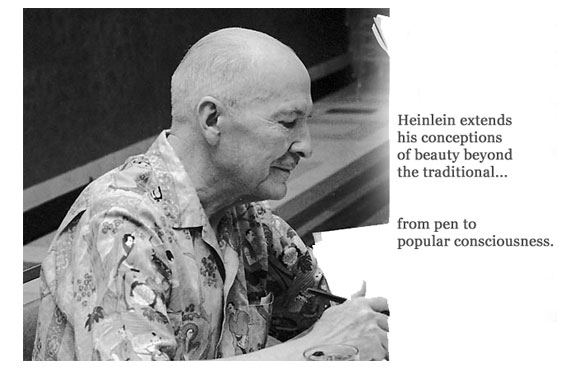
I think back to reading Heinlein’s  Stranger in a Strange Land and how the secretaries who have learned the Martian way from Valentine Michael Smith marvel at the beauty of the lined, old face of their boss, Jubal Harshaw, because of the wear and the many shocks his flesh has undergone and weathered successfully. His aged appearance makes him beautiful for this reason. This goes beyond the object beauty represented by Ryuhei Matsuda’s  beautiful boy in “Gohatto.”
Photo adapted from Wikimedia commons. user: Dd-b http://commons.wikimedia.org/wiki/File:RAHeinlein.autographing.Midamericon.ddb-371-14-750px.jpg


I suppose beauty lives in the combination of a physicality that pleases a particular observer and a deeper character-driven beauty.  It is always nice when the two combine. Somehow, fellows like Toshiro Mifune seemed to embody that Heinleinian fine wine quality in a cinematic sense. He was a dashing and handsome fellow in his young badass days, but he wears that history with a mantle of maturity well in his older countenance too. And he’s one of the few men whose strong handsome features allowed him to look really good with a shaved head. He also escaped the “seedy look” that besets many older men.  The fact that he attacked his roles with his entire soul and being added a certain depth to the outward beauty we see onscreen; this character enrichment is essential to the totality that proclaims a person to be “beautiful.” If Mifune had been merely an adequate actor, he would be nowhere near as beautiful.


But back to the idea sparked by Ryuhei Matsuda’s crying fit: the idea that we are an amalgam of our experiences is not a new one. It is an old concept. It is behind the marks of honor signified by the Heidelberg Dueling Scar or perhaps more fittingly for Matsuda, the character-defining eyepatch worn by Sengoku warlord Date Masamune, who Matsuda portrayed in the 2009 Taiga drama “Tenchijin.” According to Samurai Wiki, “In his youth, Masamune had suffered a bout with small pox that caused an infection in his right eye-which he plucked out himself. Combined with his early aggressive and unstable demeanor, Masamune would earn the tag 'One-eyed Dragon'.” The visual cue of the eyepatch made him more iconic and terrifying in combination with his personality .

The one-eyed general’s outward appearance becomes tied to his inner character traits and thus his “beauty” is made of legend, story and the transformation of physical traits. The “eye of the beholder” has swollen to encompass the whole of historical literature, and thus the beauty of Masamune and, by extension, of Matsuda who portrayed him, is amplified and given a deeper meaning than the one-dimensional plastic bishounen where he began. And this traveled path is a battle scar in itself. Forgive the rambling, not-quite-to-the-point nature of this blog post. After all, I have been shamefully neglecting the blog for a long time now, and I had to push myself to put something up here—anything. I hope it at least made a little sense to someone!

Tuesday, September 20, 2011

Why on Earth is it called "Tennessee Terakoya?"

初めまして!First, let me tell you I didn't brainstorm or sit around trying out cool-sounding names before I came up with this. It was simply a matter of wishing for an alliterative descriptor to go with "Tennessee," which is my base of operations. A terakoya is a school run out of a Buddhist temple usually, that teaches boys, girls, and often young women the arts and sciences of feudal Japan in the Edo period (1603-1868): reading, writing, history, tea ceremony, ikebana, the use of the soroban (abacus) and such. Now I'm not really a soroban whiz, but I'm pretty good at algebra! I do have a soroban around here somewhere, so when I learn to use it, I'll post my experience here! While I'm not necessarily qualified to teach all subjects to all people, I find the idea of a rural online "terakoya" or Temple School to be appealing, as much of my online life is devoted to learning more about the world and especially about Japanese history and culture. So I'm both teacher and learner. For that purpose, I utilize this particularly helpful Japanese language learning site: Nihongoup . Also this wonderful, active forum for the pursuit of all things Japanese (especially the history of the Samurai) is here: Samurai-Archives Japanese History Forum. There are many more ways to connect with the history and culture of this most fascinating country, but, as I am, for the most part, stuck without a car in the deepest of rural Tennessee 'hollers, I rely on the internet, printed word and Netflix (for entertainment).

You can find my other internet hangouts here:
Sadie Heilemann's Yahoo! Contributor Network profile
Sadie's Twitter (as @NagasakiOsada)
Sadie's Facebook page
Sadie's Klout index (I'm rather pitiful, I'm afraid, but social status ain't everything! Don't tell those Tokugawa samurai I said that!)
Samurai Fiction on Samurai-Archives.com (I've published several stories here under the moniker "Onnamusha" )

Anyway, I hope you'll enjoy reading my blog, and feel free to contact me here if you have any suggestions for great subjects to pursue at the old rural Terakoya!